Showing posts with label native plants. Show all posts

Wednesday, September 25, 2013

What If There Was No Landscaping?

What if there was no landscaping . . . only wild plant communities? 


If you have a freestanding house in America, you probably have a yard. And if you have a yard, you probably have a lawn, some foundation shrubs, and perhaps even a few flowering plants. It's a simple set of givens: house = yard = landscaping. This formula is so ingrained in our cultural DNA that it is hard to even imagine an alternative. Think about where you live. Now try to imagine all of the lawns, shrubbery, and planting stripped out of it. What could possibly replace it?

This past week, I was in coastal Alabama to see my sister get married. We had a wonderful time visiting with family and enjoying the beaches and fresh seafood. We stayed in a rented house near Fort Morgan, an isolated peninsula that separates the Gulf of Mexico from the Mobile Bay. The thin peninsula is a beautiful, yet brutal natural landscape. The soil is entirely sand; desiccating winds batter the shoreline daily; fires regularly burn large portions of the landscape; and sea surges from hurricanes inundate large portions of the peninsula every few years. 

Wednesday, March 28, 2012

Thomas Rainer to Speak at LAHR Symposium

I'm pumped about attending this year's annual LAHR Symposium hosted by the U.S. National Arboretum.  I will be speaking on "Contemporary Planting Design Using Native Plants."  It is a part rant and part how-to speech that looks at how to artfully abstract native plant communities into bold, modern garden spaces.

This year's theme for the symposium is described as "Inspiring New Directions."  Here is the official blurb:

The 26th annual Lahr Symposium explores the work of landscape architects, authors, and gardeners who were inspired by native plants to change their career paths to pursue unique callings. From journalist turned naturalist to researcher turned native fruit aficionado, these individuals explain how native plants have influenced their work. Learn how native plants can foster creativity in the garden and inspire new insights into nature and landscape design.

For complete program details, including a map and directions, see the Lahr Symposium brochure .  Registration fee includes lunch and early access to the Native Plant Sale. Fee: $89 ($71 FONA) Registration required.

Note: This year the symposium will be held at the Beltsville Area Research Center at 10300 Baltimore Blvd, Beltsville, MD.

Thursday, January 12, 2012

Perennials to Interplant in Grasses


Of all my plant obsessions, herbaceous plants are among my favorites. Several years back, I remember walking through the woods with a colleague, a tree expert. After several hundred yards, we laughed at each other. He was always looking up at the canopies, and I was always looking down at the ground—scanning the forest floor for herbaceous plants. It is my perpetual posture: head down, scanning right to left.

Amorpha canescens
As a perpetual ground-scanner, I’ve recently had a revelation about the way many perennials and grasses are meant to grow together. This revelation has influenced the way I design.

It’s actually quite simple: many perennials from meadow/prairie ecosystems have evolved to grow within a matrix of grasses. While that is not a particularly ground-breaking concept, it does challenge the way many perennial gardeners arrange their plants. Most perennial gardens focus heavily on forbs (blooming perennials) that are scattered one by one in planting beds. Grasses, if used at all, tend to be added as specimens or accents. But if you consider the way most meadow perennials grow, this ratio should be reversed. The grasses are meant to be the dominant plants with forbs emerging through this matrix.

Consider the morphology of an Echinacea (Cone Flower). Echinaceas typically have low basal foliage and tall spindly stems which support the flowers. This very structure is designed to help the plant grow out of a lot of grasses. The low foliage first emerges in late spring before the warm season grasses emerge, grabbing sunlight to ready the plant for its flowering. Once the grasses put on their height, the Cone Flower sends up its flowers on delicate stalks. The grasses support the flower (like a stake). If you’ve ever had perennials flop over, it may be because it is missing its support system.

As a gardener or designer, this does not mean that your perennial gardens need to be mostly grasses. It does, however, provide a real opportunity for people interested in designing with ornamental grasses. I love the look of large masses of ornamental grasses in a landscape. They are easy, low maintenance, have a long season of interest (particularly in winter), and add a wonderful looseness and spontaneity to a landscape.

Dalea purpurea growing in grasses

Thursday, August 4, 2011

Native Plants & The Wild Look: An Argument for Design

Marcus de la Fleur's design for a residence using native plants prompts the question: does using natives in wild patterns help or hurt the native plant movement? Image by Marcus de la Fleur
I have a conflicted relationship with wildness.

When I think about the sea of lawns and generic plantings that dominate our built landscapes, when I reflect on how quickly our native woodlands are disappearing, I yearn for more wildness. In many ways, our landscapes are too tidy. Our shrubs are too clipped, our lawns too manicured, our planted spaces too restrained. Despite recent progress with more sustainable gardens, the McLandscape is still the dominant form in our country.

"Yard of the Month"
Just to get a sense of what’s considered beautiful in our country, try this experiment: do a Google image search for the phrase “yard of the month.” The aesthetic is clear: tightly clipped evergreens smashed up against the house, an endless expanse of weedless lawns, and—for landscapes with a special flourish—a floating bed on annuals around the mailbox or a tree.

So in this context, wildness is desirable. How liberating is it to banish lawn altogether from one’s yard? How delightful is a project like the Highline that has an elevated meadow that winds between skyscrapers? How welcome are spontaneous, self-seeding wildflowers in an institutional landscape? Wildness adds an element of drama and dynamism sorely needed in our landscapes.

While I praise wildness on the one hand, I am concerned that it has become the de rigueur of native gardens these days. It is as if a native garden, by definition, must be wild and sprawling. To create a native garden is not only a statement against exotic plants, but it is a statement against traditional garden forms altogether. Almost all of the sustainable landscape techniques, including rain gardens, bioswales, and green roofs—have adopted a wild aesthetic.

So what, you might ask? Don’t we want to import not only native plants to our built landscapes, but the patterns and forms of our native landscapes? Yes, but I want native gardens to embrace a diversity of design styles. I have a couple of problems with a “natural only” look.

An advertisement for native planting, or an argument against it? Rain Garden.  Photo and design by Marcus de la Fleur
First, designing a garden or landscape with a wild look takes quite a bit of effort and planning. There’s a difference between a carefully crafted wild look and sloppy planting design. Too often, sustainable landscapes emphasize plant selection at the expense of overall composition. Plants are not massed, so they don’t have visual impact. Small wildflowers are placed next to towering prairie plants, creating a chaotic scene. Lines, form, and order are banished, so all sense of relationship to existing structures is lost. Herbaceous plants are often placed too far apart. In our effort to imitate nature, we’ve turned our back on the forms and meaning of 4,000 years of garden history.

Thursday, April 14, 2011

The Native Debate Heats Up: Doug Tallamy Takes on The New York Times OpEd

While I try to avoid link-posting on this blog, this interview in Garden Rant with scientist Douglas Tallamy is too good to pass.  Tallamy rocked the gardening world a few years ago when he published Bringing Nature Home, a book based on scientific studies that show exotic plants support exponentially less wildlife than native plants.  Tallamy, a professor and chair of the entomology and wildlife ecology department at the University of Delaware, believes that biodiversity is an essential, non-renewable natural resource that people are forcing to extinction.

Tallamy addresses some of the backlash against native plant advocacy, addressing in particular the article in The New York Time's OpEd "Mother Nature's Melting Pot" that compares negative feelings towards exotic invasive plants to xenophobia.  The Times article likens the native plant movement to the anti-immigration movement:

Friday, March 11, 2011

Favorite Native Plants

Check out today's posting on Betsy Franz's excellent site Metro DC Lawn and Garden.  I discuss some of my favorite native plants with Betsy and talk about how I like to use them in gardens.  Betsy's series on gardener's favorite natives is a great source of ideas and inspiration.  Plus, her blog site is an excellent source of news, tours, and garden information for the Washington, D.C. area.

http://www.metro-dc-lawn-garden-blog.com/2011/03/11/favorite-native-plants-thomas-rainer/

Thursday, February 24, 2011

Hot Plants for Spring 2011

With Witchhazels in bloom and daffodil buds emerging, my spring fever is nearing its peak.  I wanted to dedicate a few blogs to plants that I think will be hot this spring.  I’ve spent time going through stacks of 2011 catalogues, going to nursery trade shows, and talking to designers and breeders, so I have narrowed down my finalists.  Today’s pick for hot plants 2011:
The Genius Geum Genus
Geum 'Totally Tangerine' bred by Tim Crowther UK.  Image from Bluestone Perennials.
Try and say that three times quickly.  It’s clear that this once overlooked genus is hotter than ever this spring.  It’s easy to see why these plants have been ignored.  They tend to take a year or two to get established, can sometimes look scraggly, and don’t really stand out in a pot.  But what makes Geums uninspiring the first year turn into assets over the long haul.  By the second year, Geums really make a show and prove themselves to be long blooming additions to any border.  Plus, they come in almost every color imaginable.

Tuesday, January 25, 2011

Native Plant Myth #3: Native Plants are not as showy or ornamental as exotic plants

I am dedicating the last of my series on “Myths about Native Plants” to a subtle but widely held misconception.  I believe that this particular misconception is the number one reason that prevents people from embracing natives more fully in designed landscapes. 
Myth 3: Native plants are not as showy or ornamental as exotic plants.
It’s not that people think that native plants are ugly; rather, when it comes to choosing plants, natives are perceived to be a bit more natural, less over-the-top-bloomy than exotic garden plants.  Walk into your local garden center and just try to resist the seduction of a lipstick-red Knockout Rose or the voluptuous softball-sized flowers of a Limelight Hydrangea.  The native section, by comparison, is populated by a sad collection of leggy, dull perennials.
Dogtooth Violet
When I was in graduate school, I took my girlfriend to the local botanical garden.   I had just finished a class on native plants, and I wanted to show her how wonderful and unappreciated our local plants were.  When we arrived, the native garden was hard to distinguish from the unmanaged woodland next to it, and the only plant blooming was a Dogtooth Violet.  I got on my knees to show her how delicate and beautiful this little plant was.  It was so exquisite it barely existed.  She seemed unimpressed.  On our way out of the garden, we passed a tulip border that was so colorful, so showy, I was convinced one could see it from the moon.  She exclaimed, “Now that’s beautiful!”  I knew then my cause was lost.

Tuesday, January 18, 2011

Native Plant Myth #2: Native Plants are Not as Tough as Exotic Plants

Few issues in the gardening world generate as much heat as the debate about native plants.  As a result, native plants have developed their own dogma.  It’s that dogma that I want to set straight.  So I’m here to bust some of the top myths about native plants.  Let the smackdown continue:
Myth 2: Native plants are not as tough as exotic plants. 
This is one I hear all the time among landscape architects.  “This site is too brutal for natives,” a colleague said recently.  He was referring to an urban parking lot that would not be irrigated.  Implicit in the assumption is the belief that natives are somehow weaker and more delicate than exotics plants. 
Wild some natives like trillium
may not be tough enough
for urban areas, others are.
It’s easy to understand where this mythology comes from.  A forest of mostly native species gets razed for an office park.  The client expresses a desire to use mostly natives on the new site, perhaps as a way to mitigate the fact that an energy-sucking office park just ate a forest.  But the conditions have changed now.  The precious native ephemerals such as tiarellas, trilliums, and geraniums that thrived under the cool woodland canopy will no longer survive on the edge of a sunny parking lot, especially once the maintenance crew salts it in winter.  So the designer reverts to a “tried and true” palette of juniper, berberis, and euonymous to green the parking islands.

Thursday, January 6, 2011

Myths about Native Plants

I am a passionate advocate of native plants.  And I’m not the only one.  Native plants are as popular now as ever, which may explain why there are so many misconceptions about natives.  So I wanted to dedicate a few postings to busting some myths about native plants.  Now to the first myth.

Myth #1: Native plants are more drought-tolerant than their exotic counterparts.
One of the top reasons people give for using native plants over exotics is that natives are more tolerant of drought than their exotic counterparts.   You hear this claim spread even by knowledgeable gardeners and horticulturalists. 
Hibiscus in its native wetland habitat
Here’s the problem: it’s simply not true.  At least not as a categorical statement.  
Why not?  The claim is based in the assumption that plants in their native habitats do not require artificial watering; therefore, native plants are more drought-tolerant than exotic garden plants.  The problem with this assumption is that native plants refer to any plant indigenous to a local area.  This includes mesic (wet-loving) plants and xeric (dry) plants.  So if you are to compare a wet-loving native Rose Mallow (Hibiscus moscheutos), for example, with your average Japanese azalea, the azalea would be more drought-tolerant.  Native plants are too broad a term to categorically say that they are more drought tolerant than exotics.  Some natives are tolerant of drought; others are not.

Tuesday, August 17, 2010

Is Ecological Restoration Just Gardening?

Lagoon Park in Santa Barbara by Van Atta Associates.  Photo by Saxon Holt
I recently read a wonderful and thought-provoking article by Peter Del Tredici, Senior Research Scientist at the Arnold Arboretum of Harvard University. Del Tredici has been on my radar since he published a subtly subversive book called Wild Urban Plants that I reviewed earlier this spring. This new article posits the question: “Is ‘landscape restoration’ really just gardening dressed up with jargon to simulate ecology?’. Here is a bit more context:

“Implicit in the proposals that call for the control and/or eradication of invasive species is the assumption that the native vegetation will return to dominance once the invasive is removed, thereby restoring the “balance of nature.” That’s the theory. The reality is something else. Land managers and others who have to deal with the invasive problem on a daily basis know that often as not the old invasive comes back following eradication (reproducing from root sprouts or seeds), or else a new invader moves in to replace the old one. The only thing that seems to turn this dynamic around is cutting down the invasives, treating them with herbicides, and planting native species in the gaps where the invasives once were. After this, the sites require weeding of invasives for an indefinite number of years, at least until the natives are big enough to hold their ground without human assistance.

What’s striking about this so-called restoration process is that it looks an awful lot like gardening, with its ongoing need for planting and weeding. Call it what you will, but anyone who has ever worked in the garden knows that planting and weeding are endless. So the question becomes: Is “landscape restoration” really just gardening dressed up with jargon to simulate ecology, or is it based on scientific theories with testable hypotheses? To put it another way: Can we put the invasive species genie back in the bottle, or are we looking at a future in which nature itself becomes a cultivated entity?”  Peter Del Tredici from "Neocreationism and the Illusion of Ecological Restoration," Harvard Design Magazine.

I’ll confess: I am not an ecologist or an expert at ecological restoration. I have, however, worked with ecological restoration experts like Rutger’s Steven Handel. Consider my recent experience on a two thousand-acre agricultural site that we intended to convert into a mosaic of different native habitats. After going through the process of analyzing the site and preparing a restoration concept, my impression was that restoration was really not that different from the design process I use for any ornamental landscape. Obviously, the goals were different and our application of native habitats was based in a much more thorough site analysis. But the end result was the same: we imposed a human concept of what “nature” should be on the site. The end result would be entirely artificial and constructed.
Vernal Pool created in an area that once wasa parking. Van Atta Associates. Photo by Saxon Holt
In addition, our constructed “native” landscape would require years of intensive maintenance to get it established, and decades of ongoing management to keep it native. After this experience, Del Tredici’s analogy to gardening resonated with me.

Del Tredici’s conclusion for designers and gardeners is to “not to limit themselves to a palette of native species that might once have grown on the site.” He argues for using plants that will tolerate the conditions of the site, native or not, particularly in the tough urban conditions.

I have two responses to the article. The first is to agree with Del Tredici’s claim that ecological restoration creates “entirely artificial and constructed” landscapes. It’s absolutely true. It bursts the romantic notion that we can bring back plant and animal communities as they existed before Columbus arrived. It also challenges the myth that native plants are natural, good, low maintenance, and self-sustaining. They aren’t. They require human intervention. The sooner we can lose the mythology that “nature” will come back one day, the sooner we can get to the real work of creating entirely artificial, native landscapes that perform essential ecological services.  See my posting here for more on this.

Boardwalk at Lagoon Park in Santa Barbara by Van Atta Associates. Photo by Saxon Holt
Secondly, I disagree somewhat with Del Tredici’s direction that designers abandon the native only approach. I certainly don’t mind using some non-natives. But implicit in Del Tredici’s assumption is that natives are somehow weaker or less adaptive to the tough conditions of an urban site than some non-natives. I entirely disagree with this point.

Of course, some natives—many of which are ubiquitous in the nursery trade—are not tough enough for urban sites. The natives that are widely available in the nursery trade are mostly selected for their ornamental value. We’ve hardly explored the full potential of native systems to address the environmental challenges of the day. To judge the adaptability of native plants based on the scant selection of natives that are currently available in the trade is preposterous. Mark Simmons, a researcher at The Lady Bird Johnson Center, is doing research that proves that many native plants are much tougher than non-natives and capable of solving many of our environmental problems. I will feature an article on his research later this month.

I love articles like Del Tredici’s. The debate over natives vs. exotic plants is really a debate about what is natural. I look forward to the day when we drop our romantic notions about nature existing somewhere “out there,” and can start to focus improving the ecology of the human-impacted landscapes that we encounter every day.

What do you think?  I would love to hear other reactions to Del Tredici's article, especially any who have some experience or thoughts about ecological restoration.

Tuesday, August 3, 2010

Plant Local: Provenance Matters


The dramatic shift toward native and sustainable gardening in the last decade is remarkable. As images of giant plumes of oil spilling into the Gulf gave us all reason to despair, I drew deep comfort from seeing so many fellow gardeners join the green revolution by converting their plots into islands of biodiversity, or by plowing up their lawns and planting vegetable gardens. These small acts of resistance are reasons to hope.

Plants being propagated by tissue culture in a lab.
As the use of native plants in gardens has moved from fringe activity to mainstream practice, gardeners need to pay attention to where their native plants come from. Here’s the problem: the vast majority of plants in the nursery trade, natives included, are being mass propagated from a relatively small gene pool. For example, consider the meteoric rise of the use of tissue cultures to propagate plant. Nurseries select unique or beautiful cultivars of a plant, say for example, Itea virginica ‘Henry’s Garnet’—a truly vigorous and ornamental native shrub. They want to reproduce the ornamental characteristics of this exact plant and at the same time eliminate the possibility of genetic variation or aberrations. So they take samples of the plants tissues (such as a stem tip, node, or meristem), place it in a sterile nutrient medium and allow it to multiply. In this artificial environment, propagators can develop roots, multiply the number of plantlets, or create new embryos for artificial seed.

Now as weird science as all of this sounds, it’s not terribly different than taking a cutting of your favorite plant to share with a friend. The great advantage of tissue culture—and other asexual propagation techniques—is that it creates predictable plants. Gardeners can be guaranteed that the Itea virginica they purchased will have the deep crimson fall color, the prolific blooms, and the cascading stems of the ‘Henry’s Garnet’ cultivar. It also offers a much-needed alternative to native plants that were taken from the wild, a once prevalent practice.

The great problem with asexual propagation is that as we lose native habitats to development, the natives we are replacing them with represent a much narrower genetic pool than what existed. More often than not, the native plant you buy at your local retail nursery was probably populated by tissue culture from a native population somewhere far away. For example, how native is a plant that was derived from a source in Tennessee, propagated in a petri dish in Oregon, shipped as a liner plant to Michigan, and then delivered to a retail nursery in Massachusetts? By the time that plant hits your garden, its passport is full.
On the left, an unplanted Panicum in Texas (photo by Rick Darke); on the right, the Panicum cultivar 'Cloud Nine'
Why should you care if your Itea virginica ‘Henry’s Garnet’ came from a tissue culture that originated from a plant in Swarthmore College in Pennsylvania when you live in Alabama?  Because it could affect the performance of your plant. Plants have phenotypic variation associated with geographic sources that allow plants to adapt to the stresses of a particular locality. Local populations have adapted over thousands of years to the particular region, developing what biologists call alleles, or alternative forms of gene. An Itea from Alabama may have alleles that allow it to adapt to high humidity, while the Pennsylvania Itea might be more cold-hardy.

Provenance matters. Right now the native plant movement still relies on horticultural approach to plants—one that focuses on ornamental characteristics of plants without concern for the plant’s provenance or community. By doing this, we lose not only the allelic diversity of local plants, but also the aesthetic appeal of plants that have been perfectly evolved to a specific region.

Left: Liatris scariosa var. novae angliae only exists on Martha's Vineyard and Nantucket; Right: Liatris spicata from the Midwest
Consider another example. I worked on a few projects on Nantucket and Martha’s Vineyard where we sold the clients on the concept of a mostly native landscape. We worked with a local meadow specialist who pointed out that several of the native species we were considering had unique varieties on the island. For example, we wanted to use Panicum virgatum, but learned that the Panicum native to the islands looked completely different than Panicum you see in the tall grass prairies of the Midwest. The island Panicum was short and had this wonderful vase-like profile, whereas the Panicum evolved in the prairies was tall and upright. We also learned that the island had its own unique species of Liatris (Liatris scariosa var. novae angliae) that had evolved to stand up in the wind and salt of the islands much better than the Liatris spicata being sold on the main land. For one project, we ended up using a local propagator who grew all his plants from seeds collected on the island. Not only did we preserve the allelic diversity of the island’s plants, but our finished garden fit into the context much better than if we had used tissue-culture natives from Midwestern sources.

The copper tones of Little Bluestem collected from local seed sources have a deeper color than Little Bluestem from off island..
So how can you truly plant locally? Gardeners should support nurseries that propagate natives from local populations. If you’re not sure, ask your local nursery owner where he or she gets her plants. This strategy has been remarkably successful in supermarkets; it can work for the nursery trade as well. Choose seed sources that you know are harvested from local populations. Or even better, learn how to sustainably collect seed from wild populations. There’s nothing quite as grounding or satisfying as going into a wild landscape, gathering seed, and then raising that plant in your garden. Go local with your garden. I promise, you will love it.

Friday, July 9, 2010

Native Plants for the Cottage Garden

Ten Bold Native Plants to Update Granny's Cottage Garden

I recently read a great article in the British Gardens Illustrated magazine that took a fresh look at plants for the traditional cottage garden. I’ve always had a soft spot for cottage gardens, as they are one garden archetype that adapts as well for small American gardens as it does for British ones. Plus, the charming jumble of perennials and shrubs is a truly sustainable model for American gardens. It made me think: can we create an American cottage garden out of a purely native palette?

The answer is a resounding “yes”. American gardeners can have all the advantages of a cottage garden—the romantic appeal, the low maintenance, and the goopy prettiness of it all—with a wildlife-friendly native mix.

The key to designing a successful cottage garden is to create the appearance of abundance in small spaces. Good cottage gardens recall moments of rural landscapes: loose grasses, towering ubellifers, and architectural spires. Here a few design principles for creating a cottage garden:

1. Create volume with herbaceous plants. Good cottage gardens overflow with a voluminous massing of pernnials, grasses, and shrubs. The actual mix of species is less important than creating mass and volume within planting beds.  Americans are notoriously bad at creating this kind of massing.  If you can see mulch in your beds, your plants are too far apart. And don’t use groundcovers; cottage gardens need full, heaping beds of plants that spill over the edges.  As a rule of thumb, use plants that are two to four feet tall on average with accent perennials that reach for the sky.
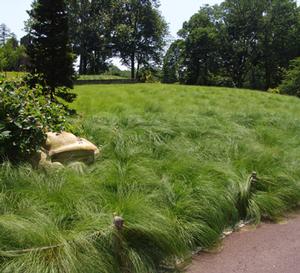
2. Use a high percentage of filler plants: The trick to making a cottage garden look good year-round is to rely on a base of filler plants. Filler plants are those that lack a distinctive shape and fill in around other plants. Think about baby’s breath in a bouquet of roses. Use ornamental grasses like Prairie Dropseed (Sporobolus heterolepsis), or cloudy perennials like Boltonia (Boltonia asteroides) as a base, and then dot in drifts of taller structural plants like Culver’s Root (Veronicastrum virginicum). The filler plants typically look good year round and create a backdrop to contrast the real stars of the cottage garden: the structural perennials.

3. Mix a variety of structural flower types: Perhaps the most recognizable feature of cottage gardens are the distinctive mix of  flower types. There’s nothing quite as romantic as a richly layered composition of architectural spires (like Baptisia), button shaped flowers (like Monarda), feathery plumes (like Aruncus), statuesque umbels (like Heracleum), and the bright daisies (like Rudbeckia).

And now, what shall we plant? If you follow the design principles above, the truly great advantage of cottage gardens is that there’s a lot of flexibility about what species you select. Here are some native plants that would be ideal for creating the cottage garden effect.

NATIVE PLANTS FOR THE COTTAGE GARDEN:

1. Wild Indigo (Baptisia australis): The colorful spires of Wild Indigo have much of the romantic effect that Foxgloves or Hollyhocks had in the English cottage garden. Used in the back of the border, Wild Indigo doubles as both a filler plant (when not in bloom) and a structural plant (when in bloom). The plant also fixes nitrogen in the soil, actually improves the fertility of your planting beds. If you like yellow in the garden, the cultivar ‘Carolina Moonlight’ is spectacular.

2. Garden Phlox (Phlox paniculata): Nothing says grandmother’s garden like the billowing blooms of garden phlox. This sweet, upright perennial reaches 3-4 feet tall, and blooms in late summer when many other perennials are spent. Great for butterflies or hummingbirds. Try some of the newer mildew-resistant cultivars like ‘David’ or ‘Katherine’.

3. Goatsbeard (Aruncus dioicus): The great William Robinson called Goatsbeard “perhaps the finest plant for the wild garden,” and I would have to agree. This edge-of-the-woods native can handle light shade or full sun if kept moist (if you live in the deep South, keep it in the shade).  In early June, the tangle of raspberry-like foliage erupts into stately cream-colored plumes. Allan Armitage claims that the males are more sought after than the females because they produce fuller blooms, but either is great in the garden.  When it's happy, it can grow as tall as five feet, but it's usually closer to three to four feet tall.  No fence line is complete without this versatile forb.


4. Joe Pye Weed (Eupatorium dubium ‘Little Joe’): Butterflies can’t resist these big clusters of mauve-pink flowers, especially Swallowtails and Monarchs. ‘Little Joe’ is a more compact cultivar (4-5’) ideal for small gardens. It’s less likely to top over than the sprawling species. 'Little Joe' can handle light shade better than the species, although it does best in sunny, moist soils in the back of the border. This cultivar has all the intense color that 'Gateway' has.

5. White Dome Hydrangea (Hydrangea arborescens ‘White Dome’): No cottage garden is complete without a hydgrangea. I like Hydrangea arborescens species because it grows more like a loose perennial than the native Oakleaf hydrangea. The large, flat disks of the cultivar ‘White Dome’ are better suited to the wilder look of a cottage garden than the goopy ‘Annabelle’ cultivar. The lacy white disks highlight the best aspects of the native species while at the same time giving it a bit of that Victorian charm.  ‘White Dome’ also dries beautifully in the winter.


6.  Cow Parsnip (Heracleum maximum): One of the most overlooked native flowers for the garden is the common Cow Parnsip.  Easily confused with the non-native Queen Anne's Lace (Cow Parsley for you Brits), Heracleum maximum is a dreamy addition to the cottage garden border.  This is the only member of the Hogweed genus native to North America.  In early summer, hummocks of architectural foliage emerge out of the base of the plant, providing a great textural contrast to finer textured perennials and grasses.  Lightly fragrant umbels unfold in late June.  Plant in groups of three of five in the midst of finer textured grasses like Sporobolus or Deschampsia flexuosa for a truly expansive effect.


7.  Swamp Rose (Rosa palustris): I fell in love with this plant while wading through the swamps of the Eastern Shore of Maryland.  The blackgum swamps were about the last place in the world I expected to see a rose, not to mention one as showy as this one is in June.  But there it was, loaded with single pink flowers that attracted a cloud of native bees.  The graceful, arching habit of the shrub was as appealing as the blooms, and bright orange rose hips and brilliant red fall color are some of the other advantages this rose has over it's exotic counterparts.  If you've had trouble raising roses because of damp soil, this plant is your answer. 


8.  Culver's Root (Veronicastrum virginicum): This perennial is a flat-out show stopper, dispelling the myth that native plants are not as showy as their exotic counterparts.  Culver's Root looks like a Veronica on steroids.  Slender white spikes that look like a candelbra crown strikingly upright stems.  It blooms for up to eight weeks in mid-July and will last as long as ten days in a vase. This plant is highly effective in the back of the border where it can be mixed with taller shrubs and grasses.  Plant in clumps of seven or more for a truly dramatic effect.  Culver's Root loves moist soil but will tolerate some drought once it is established.  Newer cultivars like the lavender-colored 'Fascination' and pinky lilac 'Apollo' will make you wonder why you ever even bothered with Foxgloves.

9.  Wavy Hair Grass (Deschampsia flexuosa): Every cottage garden needs grasses.  I don't care how smitten you are with blooms, you must make room in those beds for light catching grasses like Wavy Hair Grass.  Low grasses like these are essential in giving small gardens that expansive effect, recalling larger rural landscapes like meadows or pastures.  This particular grass is a delightful and elegant native that thrives in full hot sun or dry shade.  It can even withstand the heat and humidity of the mid-Atlantic and deep South unlike its better known cousin Deschampsia caespitosa.  In spring it is topped with feathery inflorescences that capture and hold light and sway sleepily in the breeze.  Incredibly tough and attractive year-round.

10.  Mountain Mint (Pycnanthemum muticum): My former mentor Wolfgang Oehme introduced me to this plant several years ago, and since then, it has become one of my favorite plants.  This plant is easy to overlook at first, but it will quickly become one of your most effective garden plant.  This waist-high perennial is tolerant of wet or dry, sun or shade.  And it's incredibly vigorous, slowly spreading and filling in between gaps.  Mountain Mint's silvery bracts make it a lovely foil to more brightly colored roses or perennials.  This wonderfully aromatic plant is one of the best nectar sources for native butterflies.  So when you plant it, you feel good about all the life you helped to sustain.  Plus, it makes you look good.  Whenever one of my perennial experiments does not work, or I get stuck with a problem spot in the garden, I place Mountain Mint in that spot and it almost always solves the problem. 


11.  Great Coneflower (Rudbeckia maxima): Every year I fall a bit more in love with this plant.  The king of all black-eyed susans, this Rudbeckia grows six to seven feet in height, creating a spectacle that will surely draw comments from your neighbors.  Huge powder blue leaves cover the bottom 1/3 of this plant, adding a cool contrast to green grasses or warm colored perennials.   In June and July spikes explode with large deep drooping ray flowers with a dark black center.  Goldfinches loves snacking on the seeds in late summer.  It's easy to develop a relationship with this human-sized plant.  Interplant this among low grasses or filler perennials.

Ok, gardeners, those are my top picks.  What other American natives am I leaving out that would be perfect for the cottage garden? 

If you liked this post . . .

Related Posts with Thumbnails