Showing posts with label plants. Show all posts

Thursday, May 19, 2011

Native Combinations: 2 for the Shade

Solidago flexicaulis (Zigzag Solidago) blooms on the side of the road in Vermont.  Image by Thomas Rainer
A shade tolerant Solidago?  A few years ago, I saw a beautiful clump of Solidago flexicaulis (Zigzag Goldenrod) on the side of the road in Vermont.  It was so stunning I stopped the car and pulled out the camera (my wife loves it when I do this—our vacation pictures have more plants in them than people).  Initially, I could not identify the flower.  The plant’s broad-leaves have sharply serrated edges.  That foliage combined with the glowing-yellow racemes reminded me immediately of the ornamental perennial, Ligulara ‘The Rocket’.  Was this some kind of native Ligularia I did not know?

Friday, January 21, 2011

The Case Against Mulch Rings


It’s a common sight in the American landscape: trees skirted with a ring of mulch around their base that float in a sea of lawn.  Landscapers started the practice to prevent mowers and weed eaters from damaging tree trunks, and many arborists like the protection that mulch gives to the roots.   But listen up America:  these mulch rings have got to go.  The benefits of mulch rings have long been exaggerated, and they are just plain ugly.  Consider a few reasons for eliminating this practice.
In nature, plants happily share space with tree roots.  Why do we add the rings?

Thursday, September 23, 2010

Seed Saving: A September Ritual that is Good for the Planet and your Soul

Late September is an ideal time to think about next year’s garden.  Collecting and saving seeds might be the world’s most ancient garden activity, and one of the most rewarding.  Why should you consider saving seeds?  Especially when there are so many great seed companies available?
First, it’s insanely economical.   Remember the sticker shock you got in spring at your local nursery when you HAD TO HAVE those 12 new plants?  Collecting and saving seeds cost you almost nothing.  Not only is it cheap, but it’s good for the earth.  Why?
Propagating plants from collected seed preserves the genetic diversity of open pollinated plants.  Most of the plants you buy in a nursery are propagated by some means of asexual reproduction, often through techniques like tissue culture.  While asexual reproduction guarantees you the same ornamental characteristics of the plant’s parent, all of the offspring are genetic clones of the parent.  In nature, the vast majority of flowering plants develop seeds by being pollinated openly by insects.  This means each pollinated plants gets mixed with the genetic material of another plant close by, resulting in more genetic variation.  More genetic variation creates new strains of plants that are often tougher and more resilient than their parents. 
Paper envelopes available here.
Heirloom fruits and vegetables are all the rage these days, and for good reason.  Most of the great heirlooms were the result of open pollination.  Plants that reproduce through natural means tend to adapt to local conditions over time and evolve as reliable performers.  Over the last 100 years, we’ve lost literally thousands of varieties of vegetables and flowers due to a reliance on commercial hybrid seed.  Overuse of hybrids and asexual reproduction has eroded the gene pool.  Collecting and saving your own seeds creates stronger, healthier, and more genetically diverse plants.
First time seed savers may want to collect from species that are easy to sow.  Most annuals and some perennials such as zinnias, basil, arugula, chives, borage, catnip, dill, parsley, mint, monarda, lemon balm, summer savory, and anise hyssop are easy to collect and sow again the in spring.  As you get the hang of seed collecting, try more challenging plants. 
Here are some tips for seed saving in your garden:
1. Understand the plant’s anatomy: 
Each plant has evolved remarkable techniques for developing and dispersing seed.  The first time I tried to collect seeds from my Acanthus hungaricus, I was rudely alerted to the fact that Acanthus actually catapult their seed through the air.  When touched, the dried fruits exploded from tension of it members and literally shot seeds across the yard.  I lost most of the seeds.  After doing some research, I learned how to put a bag over the dried fruits before picking them.    Some plants seeds are so small, they must be shaken in a paper bag.  Each plant is unique and learning their reproductive strategies is an entirely fascinating journey.  Do a little research first.
2.  Find out if your plant sterile:
If your plant originated from a nursery, it may produce sterile seeds.  Corporations are producing cultivars that cannot be reproduced (to protect their patent and profits).  Many popular cultivars can only be reproduced asexually.  Check the internet to see if the species and cultivar of your plant is able to seed.
3.  Make sure the seeds are ready to harvest: 
If the flower or fruit of the plant is still green or wet, it’s probably too early to harvest.  After the flowers fade and start to turn brown, it’s time to cut and dry the seeds.  It will probably take another few weeks of drying before the seed is ready to store.  Wet seeds can create fungus and other undesirable diseases.
4.  Dry the seeds in a dark, well-ventilated area:  Bright sunlight can actually kill a seed, and too damp an area spreads fungus.
5. Sift seeds through a sieve or colander: This helps to remove plant fragments from the seed.
6.  Use paper envelopes, not plastic:  Paper allows for a modest amount of transpiration, whereas plastic holds moisture. 
7. Label your packet: Remember to write the name of the plant, where and how you collected it, and the date.  This will prove entirely valuable a year or two down the road. 
To learn more about seed saving, check out these links:


Friday, July 23, 2010

Can You Spoil Plants?

Is it possible to spoil a plant?  According to science, the answer may be 'yes.'


After a wet spring, this past June was the hottest month on record in the Washington, D.C. area. As a result of this dramatic shift, I have watched my planted darlings go from plump, fat hens to emaciated whips, all in a period of a few weeks. Which makes me wonder: did all of the watering, feeding, and coddling I did in the early spring (when my garden fever is at its peak) actually spoil my plants? Did my overindulgence make them unprepared for the hot, grueling summer? Is it actually possible to spoil a plant?

Turns out, the answer may be ‘yes.’ I consulted plant science guru William Cullina whose recent book Understanding Perennials: A New Look at an Old Favorite had some revealing answers.  According to Cullina, an abundance of water and nutrients is a signal to plants that it is ok to grow, whereas drought signals to the plant that it is time to cut back. Over watering and over feeding, particularly in a closed environment like a planter, can be a problem once you stop. Just like a person who gets used to a large income, and then has a sudden decrease in salary, plants also struggle at sudden shifts.

In most areas, the amount of rainfall and available nutrients varies during different times of the year. In the eastern U.S., the month of May has a highest average rainfall of the year, while September is significantly lower. Plants adjust slightly to feast or famine by transpiring at higher or lower levels. After a soaking rain, the soil is saturated and roots can easily absorb water. But as the soil dries, it becomes increasingly hard because the remaining water becomes both progressively dirtier as it is concentrated. Some plants can actually raise the solute levels in their roots to create more osmotic pressure to suck up the water, acting like a built-in pump. However, as the soil gets drier, this phenomenon can actually reverse, causing the soil to pull water out of the plant. This is why fertilizing during drought is a bad idea. Inorganic fertilizers are essentially a mix of salt which actually pulls moisture out of plants.

Sudden drought can be particularly damaging to plants as it causes the root hairs to die and the plant stops growing. This makes absorbing water that much harder because a plant has to re-grow new roots in order to take in new water. Even if the immediate symptoms of drought like wilting and dieback go away, the long term effects of drought linger. To replace dead roots, a plant must use its food reserves it was saving for dormancy and flowering.

“Let’s say you plant a hibiscus in June and water it well for the first two weeks,” explains Cullina, “then you go off on vacation and find the poor thing badly wilted when you return three weeks later. After watering it well over the next three weeks, it appears to recover and even blooms, but then it fails to return the next spring. While cold damage would be the obvious suspect, it is equally likely that drought stress a full six months earlier is to blame.”

The solution to this problem, says Cullina, is to choose plants that are adapted to your region’s average rainfall, and then water them consistently. While the amount of rainfall from year to year may not be predicable, one reality is increasingly clear: water use is quickly outpacing the supply. Gardeners must learn to adapt to the future of water scarcity before it is too late.

Friday, July 9, 2010

Native Plants for the Cottage Garden

Ten Bold Native Plants to Update Granny's Cottage Garden

I recently read a great article in the British Gardens Illustrated magazine that took a fresh look at plants for the traditional cottage garden. I’ve always had a soft spot for cottage gardens, as they are one garden archetype that adapts as well for small American gardens as it does for British ones. Plus, the charming jumble of perennials and shrubs is a truly sustainable model for American gardens. It made me think: can we create an American cottage garden out of a purely native palette?

The answer is a resounding “yes”. American gardeners can have all the advantages of a cottage garden—the romantic appeal, the low maintenance, and the goopy prettiness of it all—with a wildlife-friendly native mix.

The key to designing a successful cottage garden is to create the appearance of abundance in small spaces. Good cottage gardens recall moments of rural landscapes: loose grasses, towering ubellifers, and architectural spires. Here a few design principles for creating a cottage garden:

1. Create volume with herbaceous plants. Good cottage gardens overflow with a voluminous massing of pernnials, grasses, and shrubs. The actual mix of species is less important than creating mass and volume within planting beds.  Americans are notoriously bad at creating this kind of massing.  If you can see mulch in your beds, your plants are too far apart. And don’t use groundcovers; cottage gardens need full, heaping beds of plants that spill over the edges.  As a rule of thumb, use plants that are two to four feet tall on average with accent perennials that reach for the sky.

2. Use a high percentage of filler plants: The trick to making a cottage garden look good year-round is to rely on a base of filler plants. Filler plants are those that lack a distinctive shape and fill in around other plants. Think about baby’s breath in a bouquet of roses. Use ornamental grasses like Prairie Dropseed (Sporobolus heterolepsis), or cloudy perennials like Boltonia (Boltonia asteroides) as a base, and then dot in drifts of taller structural plants like Culver’s Root (Veronicastrum virginicum). The filler plants typically look good year round and create a backdrop to contrast the real stars of the cottage garden: the structural perennials.

3. Mix a variety of structural flower types: Perhaps the most recognizable feature of cottage gardens are the distinctive mix of  flower types. There’s nothing quite as romantic as a richly layered composition of architectural spires (like Baptisia), button shaped flowers (like Monarda), feathery plumes (like Aruncus), statuesque umbels (like Heracleum), and the bright daisies (like Rudbeckia).

And now, what shall we plant? If you follow the design principles above, the truly great advantage of cottage gardens is that there’s a lot of flexibility about what species you select. Here are some native plants that would be ideal for creating the cottage garden effect.

NATIVE PLANTS FOR THE COTTAGE GARDEN:

1. Wild Indigo (Baptisia australis): The colorful spires of Wild Indigo have much of the romantic effect that Foxgloves or Hollyhocks had in the English cottage garden. Used in the back of the border, Wild Indigo doubles as both a filler plant (when not in bloom) and a structural plant (when in bloom). The plant also fixes nitrogen in the soil, actually improves the fertility of your planting beds. If you like yellow in the garden, the cultivar ‘Carolina Moonlight’ is spectacular.

2. Garden Phlox (Phlox paniculata): Nothing says grandmother’s garden like the billowing blooms of garden phlox. This sweet, upright perennial reaches 3-4 feet tall, and blooms in late summer when many other perennials are spent. Great for butterflies or hummingbirds. Try some of the newer mildew-resistant cultivars like ‘David’ or ‘Katherine’.

3. Goatsbeard (Aruncus dioicus): The great William Robinson called Goatsbeard “perhaps the finest plant for the wild garden,” and I would have to agree. This edge-of-the-woods native can handle light shade or full sun if kept moist (if you live in the deep South, keep it in the shade).  In early June, the tangle of raspberry-like foliage erupts into stately cream-colored plumes. Allan Armitage claims that the males are more sought after than the females because they produce fuller blooms, but either is great in the garden.  When it's happy, it can grow as tall as five feet, but it's usually closer to three to four feet tall.  No fence line is complete without this versatile forb.


4. Joe Pye Weed (Eupatorium dubium ‘Little Joe’): Butterflies can’t resist these big clusters of mauve-pink flowers, especially Swallowtails and Monarchs. ‘Little Joe’ is a more compact cultivar (4-5’) ideal for small gardens. It’s less likely to top over than the sprawling species. 'Little Joe' can handle light shade better than the species, although it does best in sunny, moist soils in the back of the border. This cultivar has all the intense color that 'Gateway' has.

5. White Dome Hydrangea (Hydrangea arborescens ‘White Dome’): No cottage garden is complete without a hydgrangea. I like Hydrangea arborescens species because it grows more like a loose perennial than the native Oakleaf hydrangea. The large, flat disks of the cultivar ‘White Dome’ are better suited to the wilder look of a cottage garden than the goopy ‘Annabelle’ cultivar. The lacy white disks highlight the best aspects of the native species while at the same time giving it a bit of that Victorian charm.  ‘White Dome’ also dries beautifully in the winter.


6.  Cow Parsnip (Heracleum maximum): One of the most overlooked native flowers for the garden is the common Cow Parnsip.  Easily confused with the non-native Queen Anne's Lace (Cow Parsley for you Brits), Heracleum maximum is a dreamy addition to the cottage garden border.  This is the only member of the Hogweed genus native to North America.  In early summer, hummocks of architectural foliage emerge out of the base of the plant, providing a great textural contrast to finer textured perennials and grasses.  Lightly fragrant umbels unfold in late June.  Plant in groups of three of five in the midst of finer textured grasses like Sporobolus or Deschampsia flexuosa for a truly expansive effect.


7.  Swamp Rose (Rosa palustris): I fell in love with this plant while wading through the swamps of the Eastern Shore of Maryland.  The blackgum swamps were about the last place in the world I expected to see a rose, not to mention one as showy as this one is in June.  But there it was, loaded with single pink flowers that attracted a cloud of native bees.  The graceful, arching habit of the shrub was as appealing as the blooms, and bright orange rose hips and brilliant red fall color are some of the other advantages this rose has over it's exotic counterparts.  If you've had trouble raising roses because of damp soil, this plant is your answer. 


8.  Culver's Root (Veronicastrum virginicum): This perennial is a flat-out show stopper, dispelling the myth that native plants are not as showy as their exotic counterparts.  Culver's Root looks like a Veronica on steroids.  Slender white spikes that look like a candelbra crown strikingly upright stems.  It blooms for up to eight weeks in mid-July and will last as long as ten days in a vase. This plant is highly effective in the back of the border where it can be mixed with taller shrubs and grasses.  Plant in clumps of seven or more for a truly dramatic effect.  Culver's Root loves moist soil but will tolerate some drought once it is established.  Newer cultivars like the lavender-colored 'Fascination' and pinky lilac 'Apollo' will make you wonder why you ever even bothered with Foxgloves.

9.  Wavy Hair Grass (Deschampsia flexuosa): Every cottage garden needs grasses.  I don't care how smitten you are with blooms, you must make room in those beds for light catching grasses like Wavy Hair Grass.  Low grasses like these are essential in giving small gardens that expansive effect, recalling larger rural landscapes like meadows or pastures.  This particular grass is a delightful and elegant native that thrives in full hot sun or dry shade.  It can even withstand the heat and humidity of the mid-Atlantic and deep South unlike its better known cousin Deschampsia caespitosa.  In spring it is topped with feathery inflorescences that capture and hold light and sway sleepily in the breeze.  Incredibly tough and attractive year-round.

10.  Mountain Mint (Pycnanthemum muticum): My former mentor Wolfgang Oehme introduced me to this plant several years ago, and since then, it has become one of my favorite plants.  This plant is easy to overlook at first, but it will quickly become one of your most effective garden plant.  This waist-high perennial is tolerant of wet or dry, sun or shade.  And it's incredibly vigorous, slowly spreading and filling in between gaps.  Mountain Mint's silvery bracts make it a lovely foil to more brightly colored roses or perennials.  This wonderfully aromatic plant is one of the best nectar sources for native butterflies.  So when you plant it, you feel good about all the life you helped to sustain.  Plus, it makes you look good.  Whenever one of my perennial experiments does not work, or I get stuck with a problem spot in the garden, I place Mountain Mint in that spot and it almost always solves the problem. 


11.  Great Coneflower (Rudbeckia maxima): Every year I fall a bit more in love with this plant.  The king of all black-eyed susans, this Rudbeckia grows six to seven feet in height, creating a spectacle that will surely draw comments from your neighbors.  Huge powder blue leaves cover the bottom 1/3 of this plant, adding a cool contrast to green grasses or warm colored perennials.   In June and July spikes explode with large deep drooping ray flowers with a dark black center.  Goldfinches loves snacking on the seeds in late summer.  It's easy to develop a relationship with this human-sized plant.  Interplant this among low grasses or filler perennials.

Ok, gardeners, those are my top picks.  What other American natives am I leaving out that would be perfect for the cottage garden? 

Wednesday, June 30, 2010

Experts Rediscover Ancient Fern Presumed Extinct

Article from Science reporter, BBC News

"In a small, noisy labratory, tucked away in London's Royal Botanic Gardens at Kew, a tiny plant is growing.

It looks just like a very small parsley bush, but it is actually a very special little plant indeed.  Clean air has to be constantly circulated in the lab to protect it from any bacteria.  This precious specimen is the Anogramma ascensionis fern, commonly known as the parsley fern. Since the 1950s, botanists believed it to be extinct.

It is native to Ascension - an island in the South Atlantic, which is one of Britain's overseas territories. And a small project supported by Kew's overseas territories programme has rediscovered and rescued it - a timely success story, as this year has been dubbed International Year of Biodiversity.

Kew botanist Phil Lamden and local conservation officer Stedson Stroud found the plucky little plant clinging to a precarious existence on a mountainside in the harsh volcanic landscape.  "We were down the back of Ascension's Green Mountain, which has very, very steep slopes. You have to be really careful because if you slip you're a goner," Mr Stroud recalled. "And we came across this beautiful little fern and immediately knew it was the lost Anogramma that had been extinct for the last 60 years."

Ascension is covered by bleak, forbidding lava flows, and only 10 plant species are known to be truly "endemic" - found nowhere else in the world.

Read full article: http://news.bbc.co.uk/2/hi/science_and_environment/10402534.stm

Monday, June 14, 2010

The End of Groundcovers

If I could banish one word from the English language, it would be "groundcover."  The era of the groundcover must end.  While this age of American landscape design has its roots in the Victorian garden, it has been the dominant landscape ethos since the post WWII housing boom.  The primary idea of this era is that non-lawn planting beds need to be covered in a low maintenance, evergreen groundcovers such as English ivy, periwinkle, or pachysandra.  The results of this philosophy on our landscapes are nothing short of catastrophic: millions of acres of meadow and forest have been decimated by these invasives, and we've forsaken the spiritually enriching act of gardening for the environmentally impoverishing act of landscaping.

The Rise of the Groundcover
It's easy to understand how groundcovers became so popular.  As American suburbs sprawled away from city centers, individual homeowners quickly became absorbed in the enormous labor of maintaining huge expanses of lawn.  With so much lawn to maintain, the rest of the yard needed to be relatively maintenance free.  Planting beds were established where lawn wouldn't grow--typically in the shady areas under trees or at the edge of the lot.  How to fill these leftover beds became a problem.  Next to a manicured lawn, bare earth or mulch looks empty and unfinished, but filling these large areas with plants could be expensive. 

The groundcover became the magic cure.  Tolerant of sun or shade, wet or dry, these low, creeping plants could be sparsely planted in a bed and left alone.  Within a year or two, the bed was covered in lush carpet of glossy green ivy, the bright blue flowers of periwinkle, or the happy white spires of pachysandra. When maintained, the long flowing curves of planting beds created sinuous lines against the lawn, a declaration of the well-tended yard.

But the problem was that these yards were inevitably not well-tended.  The very quality that initially drew homeowners and landscapers to these plants--their ability to spread--became the beginning of an aesthetic and ecological disaster. 

Ecological Disaster
The honeymoon period (two or three years after the installation) yielded to the invasive period, and homeowners quickly realized that these low maintenance darlings actually required maintenance--lots of maintenance.  The plants began to move and destroy: the ivies grew up trees and down slopes; pachysandra crept into a wet area and down stream channels; periwinkle moved across slopes choking all other vegetation in its path.  Not even structures were safe.  The clinging roots of ivies invaded mortar, the muscular branching of wisteria damaged buildings, and the thick impenetrable roots of periwinkle altered the hydrology of yards. [Image to left shows Vinca major, periwinkle, smothering a forest floor].

Often in suburban neighborhoods, the developer backs lots right up against undevelopable land like forested streams or adjacent woodlots.  The groundcovers, unaware of property lines, spread into forests, streams, and meadows.  Vines climb into the canopy, covering leaves and blocking photosynthesis.  The additional weight of the vines often break branches and canopies particularly during snow.  The understory invasives smother the ground-plane, preventing native plants from seeding and regenerating the canopy.  Ecologists call the zones dominated by invasive groundcovers "ecological dead zones." [Image on right shows English ivy decimating forest floor and smothering trees.]

The U.S. Forest Service now estimates that invasive plants like groundcovers strangle 3.6 million acres of national forests, an area the size of Connecticut.  And that's just national forests.  Invasive plants are thought to cover 133 million acres of federal, state, or private land, an area the size of California and New York combined.  Each year invasives march across 1.7 million acres, almost double the size of Delaware. 

An Alternative Concept
The concept behind groundcovers is as pernicious as the plants themselves.  It is based on the mythology of the quick and easy, low maintenance yard.  Groundcovers signal a disconnect between the owner and the land, a message saying "I don't want to deal with you".  The professionals who use these plants, both designers and contractors alike, automatically assume the lowest possible expectations for that piece of land.  Groundcovers are chosen based on the assumption that the area will be ignored, abused, or abandoned. 

Groundcovers represent a failure of the imagination.  Americans understand trees, shrubs, and groundcovers, but beyond these categories, we're pretty much lost.  We lack England's rich garden history and thus fail to understand how to use herbaceous plants like perennials, grasses, annuals, or vines to enrich our planting beds.  Native plant enthusiasts have long recommended native alternatives to invasive groundcovers, but their suggestions typically replace one type of plant with a less invasive counterpart (a vine for a vine, a creeper for a creeper).  What these lists fail to do is to challenge the aesthetic that prompts the homeowner to use a groundcover in the first place. 

The alternative to groundcovers is not slightly less invasive groundcovers, but planting beds filled with native biomass.  We need to re-imagine our beds filled with a rich tapestry of perennials, grasses, shrubs, and low trees.  While our unfamiliarity with these materials make them intimidating, we should rely on the toughest and most resilient native perennials and grasses to fill our borders.  The demand for evergreen should be replaced with plants that provide winter interest: dried grasses, seed heads, and structural deciduous shrubs.  We should transform our ecological dead zones into ecological hotspots by creating connected areas of native biomass.  When we do this, we invite pollinators and birds back into our landscapes. 

[Native biomass: Goldenrod and Echinacea fill a planting bed.  These plants are low maintenance, provide nectar for birds and butterflies, and beautiful as they change through the seasons.]

A Model Project

Ten Eyck Landscape Architects in Phoenix recently completed an award winning project for a labratory building for the University of Arizona.  The landscape around the building functions both as an outdoor classroom and a high performing native landscape.  The project harvests water and provides and interface between students and nature.  The former grayfield is now a thriving habitat for birds such as the roadrunner and hawks searching for ground mammals.  The ASLA awards jury said of the project, "This project shows us everything that we should find in a university landscape.  Not a blurred interpretation of "native" but rather a commitment to accuracy." 

[Students enjoy a break at an outdoor classroom surrounded by vegetation native to the Upland Sonoran.  Photo by Bill Timmerman.]

[The pond is home for endangered fish and is listed by the U.S. Fish and Wildlife Service as a "Safe Harbor" urban site.]

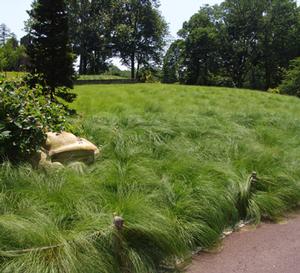
And I'm including one additional image to show how native grasses can be used as a groundcover alternative.  This photo taken at Chanticleer Garden in Pensylvania by Rick Darke. 

[Native grasses such as Prairie Dropseed, Sporobolus heterolepsis, make an ideal alternative to invasive groundcovers.  Photo by Rick Darke.]

Thursday, June 10, 2010

The Healthiest Fruit on the Planet Happens to be a U.S. Native

If I could plant only one woody plant in my garden, and I wanted one for year-round beauty, wildlife habitat, and ethnobotanical curiosity, the Aronia shrub would be a top choice. Tolerant of wet or dry soils, clay or sand, sun or even a little shade, this easy going native plant is beautiful and adaptable.

This genus is recently receiving international acclaim for its purported health benefits. The berries of the native Aronia melanocarpa (Black Chokeberry) apparently have the highest amount of antioxidants of any fruit yet measured. The USDA gave the Aronia berry an ORAC score (Oxygen Radical Absorbance Capacity—a measure of total antioxidants) of over 16,000, almost triple the amount of antioxidants of other powerhouses like acai, blueberries, or blackberries. The intense concentration of flavonoids and anthocyanins in the Aronia berry helps the body fight off viruses, allergies, and carcinogens.

In addition to antioxidants, the berries have been proven to aid with diabetes, cardiovascular health, and the circulatory system. A recent study by the USDA showed that regular consumption of Aronia berry extracts actually slows the intake of insulin in the body, thus inhibiting weight gain. Theoretically, these findings suggest that Aronia might lead of lower risk of diabetes and heart disease.

[Image from Fine Gardening.com]

While Aronia was widely used by Native Americans for teas, medicines, and cooking, European settlers generally ignored this plant. Commonly called Chokeberry, the plants berries have a sharply sour and sometimes astringent taste. The unpleasantness of the raw fruit can be overcome by cooking or processing it into jams, salsas, or baked goods. The internet abounds with recipes that show how to tame the sharp taste of the raw berry.

Aronia cultivation is now growing in the Midwest. Farmers are taking advantage of this native plants’ easy culture to cater to an increasing demand for the healthful berries. The organic farm, Sawmill Hollow, in Iowa cultivates 13,000 chokeberries and hosts an annual Aronia Festival in September. The farmers allow locals to come and pick berries, and sell Aronia jams, syrups, barbecue sauces, and salsas. A recent article from the Des Moines Register features the farm.

ORNAMENTAL VALUE

I’ve longed loved the Aronia genus for its ornamental value long before I knew its health benefits. Because I plant in large masses of perennials or grasses, the Aronia is an ideal companion shrub. The plant’s loose, upright character allows you to underplant them with other ornamental native perennials or grasses. The plant does not shade out the ground plane. Since the plants are somewhat spindly, I’ve had good luck by massing five or ten of them together to form a bit of a thicket. They are deciduous, so consider placing them in front of a hedgerow, or in the back of your flower border for best effect.

And the effect is indeed wonderful. In late spring the glossy leaves are loaded with clusters of white flowers which pollinator’s love. By late summer, the flowers turn into showy red or black berries which will attract a wide range of local or migratory birds. The fall color is possibly the most outstanding feature of the plant. Most Aronias turn a brilliant red color with strong oranges, purples, and yellows.

 [Aronia arbutifolia 'Brilliantissima' in background shown at maturity for planting I designed while at OvS.]

My favorite ornamental cultivar is Aronia arbutifolia ‘Brilliantissima’. The upright habit, full blooms, bright red berries, and intense fall color are outstanding on this plant. If you want to grow the plant for its healthful berries, I would recommend Aronia melanocarpa ‘Viking’. This European cultivar is apparently one of the more productive black-berried plants. For a compact cultivar, try Aronia melanocarpa ‘Iroquois Beauty’, developed by the Morton Arboretum. The wonderful folks at Lazy S’s Farm sell a wide variety of Aronia cultivars mail order through the internet. Here is a link to that page.

Thursday, June 3, 2010

Groundbreakers: The Garden Heard Round the World

It was the garden heard round the world. Beth Chatto’s garden in Essex, England, is perhaps the single most influential garden of the last century. The rather modest gardener with a unique flair for underappreciated plants stirred the waters of British gardening, and as a result, sent ripples throughout the world. Begun in 1960 on a farm property that was a wasteland of "starved gravel and soggy bog,” Beth Chatto transformed the site by creating a string of contrasting yet complementary gardens. Chatto embraced the site’s difficult features and matched plants to fit the inhospitable terrain.

Beth Chatto is the grand dame of English gardeners, the reigning heir of William Robinson, Gertrude Jekyll, and painter-gardener Sir Cedris Morris. Though not the first naturalistic gardener, Chatto nonetheless is the pioneer—the first garden structuralist—who blazed the way for brilliant plantsmen like Dan Pearson and Piet Oudolf. “Success depends on knowledge of plant provenance and on an understanding of natural plant associations,” writes Chatto in her book The Dry Garden. Chatto credits her late husband, horticulturist, and farmer for creating an interest in natural plant associations. Andrew spent his life studying where garden plants originated. Her husband’s passion for ecological patterns stirred a curiosity in Beth that would fuel her most daring garden experiment.

Her most famous and influential garden is the Gravel Garden. Begun in 1991 as a horticultural experiment, the Gravel Garden was converted from a former parking lot. Chatto was inspired by hikes she and her good friend, the legendary Great Dixter gardener Christopher Lloyd, took through various countries. During these walks, Chatto would notice how native plants would miraculously thrive in the harshest conditions, from salt-crusted sand dunes to wind-battered alpine rockeries. Inspired by the “miracle of growing plants,” Chatto set home determined to prevail with her experiment. The site was a heavily compacted parking area that consisted mostly of yellow gravel that went twenty feet deep. Chatto carefully prepared the soil (including subsoiling and several homemade blends of compost), cut in beds by using a hose to lay them out, and selected plants to fit the harsh conditions.

The most revolutionary part of the Gravel Garden is that it has never once been artificially watered. This is especially remarkable when you consider how ornamental and colorful the garden is year-round. The Gravel Garden is not a dry meadow or succulent garden, but a richly-layered perennial garden. This feat is doubly impressive considering that Essex is perhaps the driest corner in all of England.

Of course, Chatto’s concept garden would not have been a success had it not been stunningly beautiful. Chatto began her career arranging flowers, and it is her flair for arranging boldly structural plants in strikingly original combinations that accounts for her critical acclaim. As a founding member of the Colchester Flower Club, Chatto’s experience arranging plants in vases shows itself in her gardens. Chatto structures the garden with tall vertical plants like verbascum, acanthus, and foxgloves (“church spires in my village”); then artfully creates mass with textural filler plants like eryngium, euphorbia, or santolina; finally, she punches through the texture with moments of startling contrast—a luminous Stipa pulcherrima—resolving the tension between the architectural lines and the soft mass.

Chatto’s international fame came as a result of winning medals at the Superbowl of British gardening, the Chelsea Flower Show. Chatto won her first medal in 1976 and went on to win ten more gold medals during subsequent years. The show attracts thousands of visitors a year, and her unusual yet seductive combinations launched Chatto as an international garden figure. Her ability to mix traditional garden flowers like delphiniums and roses with weedy thistles, grasses, and structural seedheads gave her designs an edge and freshness that few could match. Chatto went on to publish several books, including The Dry Garden and The Damp Garden, that became instant garden classics.

Beth Chatto is widely celebrated for being one of the first ecological gardeners. But she describes her philosophy of pairing the right plants to the right habitat as nothing more than common sense. While her Gravel Garden rightfully deserves the attention it has received for its sustainable approach, it is her artistry in plant combination and natural association that makes her a Groundbreaker. Chatto orchestrates an international ensemble of plants into combinations that have the same resonance and harmony of a native palette. Like no one else before, Chatto understands form, color, and texture not as abstract design principles, but as an extension of a particular place.

For Chatto, all of the acclaim and attention her garden has received is missing the point. "Our time is so ephemeral, and no one can say how long any garden will last,” says Chatto, now 87 years old. “It is being part of that continuous chain, passing on plants and the love of plants from generation to generation, that matters."


Sources:

The Dry Garden, Beth Chatto and Steven Wooster 2001.
Beth Chatto Exhibition: A Revoutionary Revisited.” Telegraph. 13 November 2008.
All photos by Steven Wooster.

Thursday, May 27, 2010

The Perfect Antidote to Trademarked Plants

“The chief vice in gardens is to be merely pretty,” wrote American landscape architect Fletcher Steele in the 1930’s. “I believe there is no beauty without ugliness and that it should not be otherwise. Both are capable of stinging us to live.”

This quote has been swirling through my head lately, especially when I encounter advertisements for the latest hyper-hybrid, monster-blooming shrub or perennial. The Proven Winners plants, for example, have become the Barry Bonds of nursery plants. Or what’s worse, now we have celebrity gardeners like P. Allen Smith’s who have trademarked their own laboratory-bred Platinum Collection plants. The American horticultural industry seems bent on producing engineered plants that bloom eternally. Mophead hydrangeas no longer mark the beginning of summer, thanks to the Endless Summer Hydrangeas (trademark). Encore Azaleas promise blooms spring, summer, and fall. What does a fall blooming azalea mean, anyways?

Of course, there’s nothing wrong with loving big flowers. Just this week, I passed a neighbor’s peony border with softball-sized magenta blooms. It was glorious. But a garden with nothing but genetically-engineered super-bloomers is a like inviting only models to a dinner party. When prettiness trumps character, we all lose.

Which is perhaps why this year I have been seduced by an ancient family of plants. During some deep winter garden reading, I started to make connections between several bizarre, yet fascinating plants. Turns out, they all belong to the remarkable nightshade (Solanaceae) family. Plants of the nightshade family are the perfect antidote to overly-bred bloomers. First, most of these plants are anything but pretty. This year, I’m growing the rather grotesque Naranjilla plant (Solanum quitoense). It is a nasty looking plant: its massive leaves are covered with deep purple spikes. This ancient Incan plant produces little orange fruits that I understand taste like a cross between rhubarb and lime.

Solanum quitoense in a mixed border [image from Landcraft Environments LTD]

What’s more, the ethnobotanically complex nightshade family includes two of the world’s most popular vegetables: potatoes and tomatoes. Those two plants alone shape the history and cuisines of many of the world’s cultures. Nightshades also include egglplants, peppers, tobacco, and many berries. However, the tomato wasn’t always universally beloved. It was the tomato’s resemblance to the deadly nightshade plant (Solanum nigra) that slowed its acceptance in Europe.

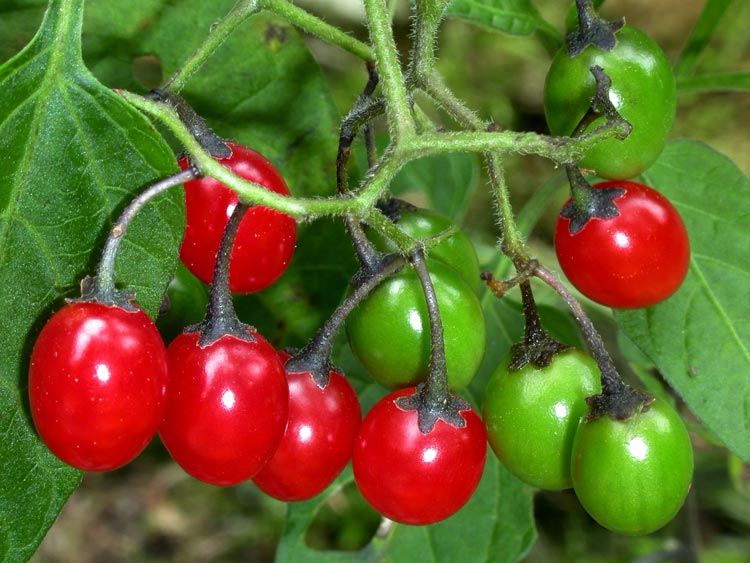
Perhaps the dark and dangerous history of these plants is what makes this family so seductive. While some of the plants create the most nourishing comfort foods on the planet, others are downright deadly. Snakeberry (Solanum dulcamera) has egg shaped red berries just like a cherry tomato that contain high levels of the phytochemical solanine. Solanine is known to cause birth defects, hallucinations, convulsions, fits of laughter, coma, and even death. Even potatoes and tomatoes contain small levels of solanine. Other nightshades contain tropane alkaloids. The term tropane is named after the Greek Fate, Atropos, who cut the thread of life. Tropane alkaloids are found in nightshade ornamentals like Datura and Brugmansia.

Like living dangerously? Several respectable seed sources sell Garden Huckleberry (Solanum nigrum var. melanocerasum), a variant of the deadly nightshade. Several regions of our country make jams and pies from the berries of this plant.  Be careful though:  others claim this plant causes defects of the central nervous system. Want to play it safe, but still explore the wonderfully bizarre world of nightshades? Try the Pepino Melon (Solanum muricatum), a compact South American shrub that produces fruit the size of a large goose egg. Beautifully pendulous cream colored fruit has purple stripes. The fruit has sweet, mild flesh that is somewhat melon-like.

Pepino, Solanum muricatum [Image from B&T World Seeds]

Nightshades are a reminder that there once was a time when plants could strike fear in the human heart. This year, I passed on the goopy Endless Summer Hydrangea and instead planted a nasty looking Naranjilla. It’s massive leaves studded with purple spikes greet me each morning, a reminder that out of fear and understanding, comes respect.

Want seeds of some of the plants mentioned? 
Baker Creek Heirloom
Top Tropicals

Monday, May 24, 2010

Oxford Study Finds that Ivy Can Protect Walls

[Image from Mayang.com]
This article has been linked from The University of Oxford.  For original link, click here.

"The received wisdom that ivy destroys buildings has been overturned by a new study by Oxford University.

In a three-year project, Oxford researchers analysed the effects of ivy growing on buildings in five different parts of England and discovered that the plant plays a protective role. They found that an ivy canopy was like a thermal shield, combating the extremes of temperature which often cause walls to crack.

English Heritage commissioned Professor Heather Viles of Oxford University's School of Geography and the Environment to analyse the effect of common ivy (Hedera helix) to guide them in their important role as the steward of hundreds of historical sites. Professor Viles’s research team monitored the effect of ivy on walls situated in different parts of the country with varying climates and challenges.They found that ivy acted as a thermal blanket, warming up walls by an average of 15 per cent in cold weather and cooling the surface temperature of the wall in hot weather by an average of 36 per cent. The ivy was also found to absorb some of the harmful pollutants in the atmosphere. Walls where ivy was growing were less prone to the damaging effects of freezing temperatures, temperature fluctuations, pollution and salts than exposed walls without ivy.

Professor Viles said: ‘Ivy has been accused of destroying everything in its path and threatening some of our best loved heritage sites. Yet these findings suggest that there are many benefits to having ivy growing on the wall. It not only provides colourful foliage but also provides walls with weather-proofing and protection from the effects of pollution.’

Garden walls at some of Oxford University’s old colleges (Trinity, Pembroke and Worcester Colleges) as well as the Old City Wall were test sites in Oxfordshire. Elsewhere, the research team examined whether ivy at the Dover Drop Redoubt site, one of a series of forts at Dover Western Heights, was friend or foe. Other walls were tested at Byland, North Yorkshire; Nailsea near Bristol; and Leicester in the Midlands.

The Oxford team used resistivity methods to monitor wall moisture levels and fixed monitors to measure the temperature and relative humidity of the microclimate beneath the ivy canopy as compared with uncovered walls. They also conducted laboratory analyses to examine the role of ivy in more detail.

The findings suggest that ivy has protective qualities for buildings that are intact; but they also showed that where walls are already damaged ivy rapidly finds its way into existing cracks and holes in walls. The researchers have built a test wall, planting ivy at the base, at Wytham Woods in Oxfordshire. The cube-shaped wall contains different flaws so researchers can measure and compare the different deterioration rates with and without ivy.

The project provides those working for English Heritage as well as gardeners up and down the land with a better idea of how to treat ivy. Many might otherwise be unclear about whether to cut down ivy climbing up the walls of their garden and home.

Alan Cathersides, Senior Landscape Manager at English Heritage, said: ‘English Heritage are always keen to avoid unnecessary work to monuments and hope this research will lead to a more balanced approach to ivy. Removal should not be automatic as so often in the past, but a carefully considered element of long term management.’

Out of this study, English Heritage hope to issue guidelines for staff and provide guidance for the public on their website by early next year. Meanwhile, Professor Viles and Dr Troy Sternberg of Oxford's School of Geography and the Environment, and Alan Cathersides, from English Heritage, will be speaking about the project and providing practical guidance at a one-day conference on ivy at the Geological Society of London on Wednesday 19 May. "

If you liked this post . . .

Related Posts with Thumbnails